

Best Luxury Hotels in Hiroshima: 8 Top Stays from the City to Miyajima (2026)

This article contains affiliate links. Learn more
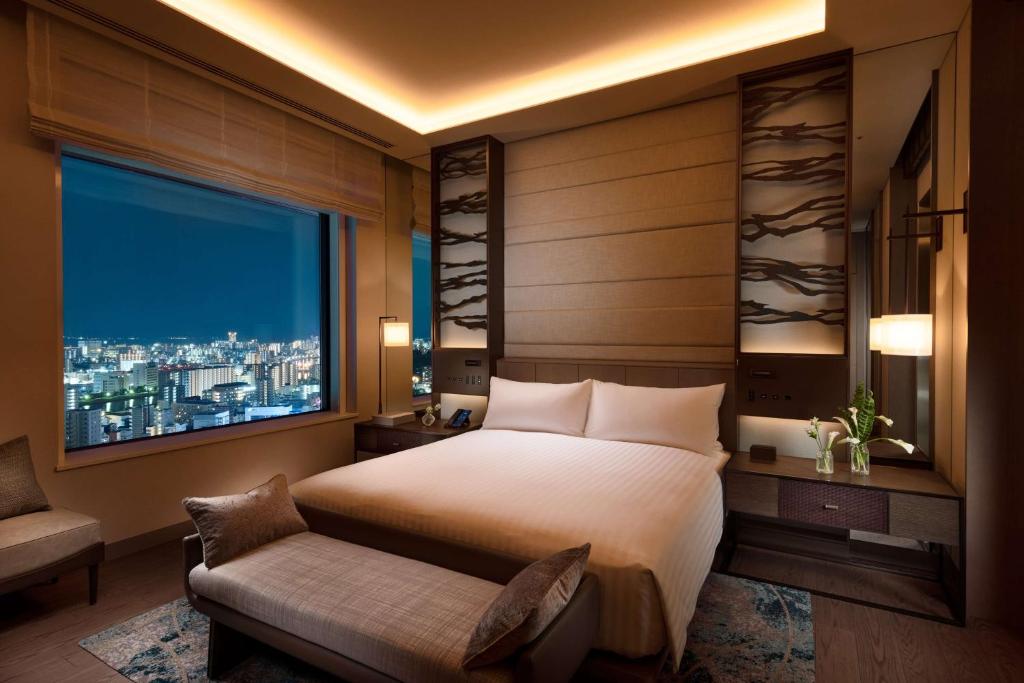
Most visitors see Hiroshima’s Peace Park and Miyajima island in one rushed day, but stay the night and you get Miyajima after dark and quiet island mornings on the Seto Inland Sea. If you’re not sure where to start, the top recommendation is Sheraton Grand Hiroshima, right by the shinkansen and an easy base for Miyajima and the towns and islands of the Inland Sea.
Here are 8 luxury stays, each chosen for something the others don’t offer, from the city to Miyajima and the islands.
Quick picks: which Hiroshima hotel is right for you?
| If you want… | Stay at |
| Step off the bullet train and into your hotel | Sheraton Grand Hiroshima Hiroshima city · US$200–400 |
| Walk to the Peace Park and downtown from a modern hotel | Hilton Hiroshima Hiroshima city · US$120–300 |
| Sleep inside a work of architecture by Shigeru Ban | Simose Art Garden Villa Otake · US$1,000–1,500 |
| Stay in a restored merchant estate on a Shimanami Kaido island | Azumi Setoda Takehara & Shimanami · US$600–1,400 |
| Soak in a hot spring with a Japanese garden and a view of Miyajima | Sekitei Miyajima & Miyahama · US$700–1,000 |
| Have Miyajima to yourself after the day-trippers leave | Iwaso Miyajima & Miyahama · US$450–750 |
| Stay on Miyajima’s main street in a modern ryokan | Itsukushima Iroha Miyajima & Miyahama · US$450–650 |
| Sleep in an old merchant house in a historic salt town | NIPPONIA HOTEL Takehara Takehara & Shimanami · US$300–600 |
Prices are rough guides per room per night and change with dates and demand.
Where to Stay in Hiroshima: City, Miyajima or the Islands
Hiroshima’s highlights are spread out: Hiroshima city itself, Miyajima island to the southwest, Otake farther west, and the historic town of Takehara and the Shimanami Kaido islands to the east. Where you sleep shapes the whole trip.
Hiroshima city, Miyajima and the Seto Inland Sea: where the hotels are
Hiroshima city is to the north, Miyajima to the southwest, Otake farther west, and Takehara and Setoda (Shimanami Kaido) to the east. Tap a number to jump to that hotel.
- 1Sheraton Grand HiroshimaHiroshima city · Right by the Shinkansen (North) Exit of Hiroshima Station›
- 2Hilton HiroshimaHiroshima city · About a 15-minute walk to the Peace Park›
- 3Simose Art Garden VillaOtake · ~10 min by car from JR Otake Station (shuttle by reservation)›
- 4Azumi SetodaTakehara & Shimanami · Near Setoda Port on Ikuchi Island, by ferry from Mihara or Onomichi›
- 5SekiteiMiyajima & Miyahama · Miyahama Onsen, ~5 min by car from JR Onoura Station (shuttle on request)›
- 6IwasoMiyajima & Miyahama · In Momijidani valley on Miyajima, walkable to Itsukushima Shrine›
- 7Itsukushima IrohaMiyajima & Miyahama · About 5 min on foot from the ferry pier and the shrine›
- 8NIPPONIA HOTEL TakeharaTakehara & Shimanami · Inside Takehara’s historic preservation district›
Simplified map. Distances and directions are approximate.
Hiroshima city: transport and the Peace Park
This covers the area around Hiroshima Station and downtown near the Peace Park and Kamiyacho. With the shinkansen, JR trains to Miyajima and the streetcar network all close at hand, it’s the easiest base for first-timers and day trips.
Sheraton Grand Hiroshima is at the station, and Hilton Hiroshima is within walking distance of the Peace Park.
Otake: architecture and art
West of Miyajima along the coast, in the city of Otake, Simose Art Garden Villa is a museum and villa complex by architect Shigeru Ban. It pairs easily with a Miyajima visit.
Takehara and the Shimanami Kaido: old towns and island time
East of Hiroshima city lie Takehara, a preserved Edo-period merchant town, and Setoda, a port town on an island along the Shimanami Kaido cycling route. Both are best with an overnight stay.
Azumi Setoda and NIPPONIA HOTEL Takehara are here.
Miyajima and Miyahama Onsen: the island at night
Miyajima, officially Itsukushima, is the island with the famous “floating” torii gate of Itsukushima Shrine, a UNESCO World Heritage Site. It’s at its best from late afternoon to early morning, after the day-trippers leave.
Across the water on the mainland, the small hot-spring area of Miyahama Onsen is home to Garden Inn Sekitei, where you look out at Miyajima from a garden. To sleep on the island itself, choose Iwaso or Itsukushima Iroha.
As a rough guide, expect US$1,000+ per night for the architect-designed villas, US$300–1,400 for ryokan (traditional inns) on Miyajima and the islands, and US$120–400 for city hotels. Ryokan rates usually include dinner and breakfast, so they’re not directly comparable with a room-only city hotel.
Book early for autumn foliage (around November) and cherry blossom season (around early April).
The 8 Best Luxury Hotels in Hiroshima
1 Sheraton Grand Hiroshima Hotel

- Area
- Hiroshima cityRight by the Shinkansen (North) Exit of Hiroshima Station
- Price guide
- US$200–400 per night
- Best for
- Travelers arriving by shinkansen and making day trips in several directions
Highlights
✅ Steps from the station’s Shinkansen Exit, easy with big suitcases
✅ JR to Miyajima, streetcars downtown and the shinkansen all start here
✅ An indoor pool for winding down between day trips
Why stay here
The Sheraton Grand is all about being right at Hiroshima Station. You can step off the bullet train and check in without dragging your suitcase through the streets.
Almost every trip out of Hiroshima starts at this station: JR trains to Miyajima, streetcars to the Peace Park, and trains toward Takehara and Setoda. If you plan to head off in a different direction each day, this is the easiest base.
On the day you move on to Osaka, Kyoto or Tokyo, you can enjoy a slow breakfast and still be on the platform in minutes.
2 Hilton Hiroshima
- Area
- Hiroshima cityAbout a 15-minute walk to the Peace Park
- Price guide
- US$120–300 per night
- Best for
- Travelers who want time in the city itself, plus a pool and spa
Highlights
✅ Walkable to the Peace Park and downtown restaurants
✅ A pool and spa to unwind after a long day
✅ The best value in this guide, an easy first night in Hiroshima
Why stay here
Hilton Hiroshima is a base for exploring the city on foot. You can walk to the Peace Park, and the downtown streets full of okonomiyaki restaurants and the Hondori shopping arcade are close by.
With a pool and spa, it’s a good place to recover after a long shinkansen ride or an emotional day at the Peace Park.
It’s the most affordable hotel in this guide. A good plan is to spend your first night here seeing the city, then move to Miyajima or the islands.
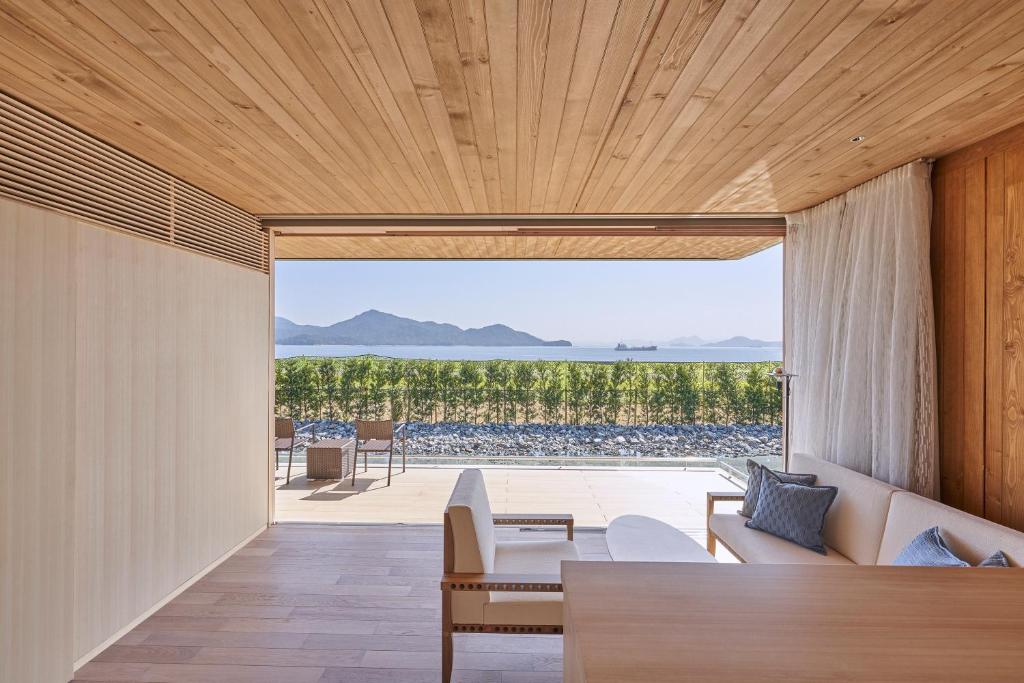
3 Simose Art Garden Villa
- Area
- Otake~10 min by car from JR Otake Station (shuttle by reservation)
- Price guide
- US$1,000–1,500 per night
- Best for
- Architecture and art lovers looking for a one-of-a-kind stay
Highlights
✅ Villas and an art museum designed by Pritzker Prize winner Shigeru Ban
✅ A waterfront site on the Inland Sea with a museum and restaurant
✅ Close to Miyajima and Iwakuni’s Kintaikyo Bridge
Why stay here
Simose Art Garden Villa is a museum and villa complex designed by Shigeru Ban, the Pritzker Prize-winning Japanese architect known for paper-tube buildings and disaster-relief housing.
A museum, a restaurant and villas in different shapes sit along the Seto Inland Sea. This is a stay where the building is the experience, and for architecture fans it’s worth the trip to Hiroshima on its own.
The museum is open to day visitors, but staying overnight gives you the quiet evening hours. It’s just west of Miyajima, so the two pair easily.
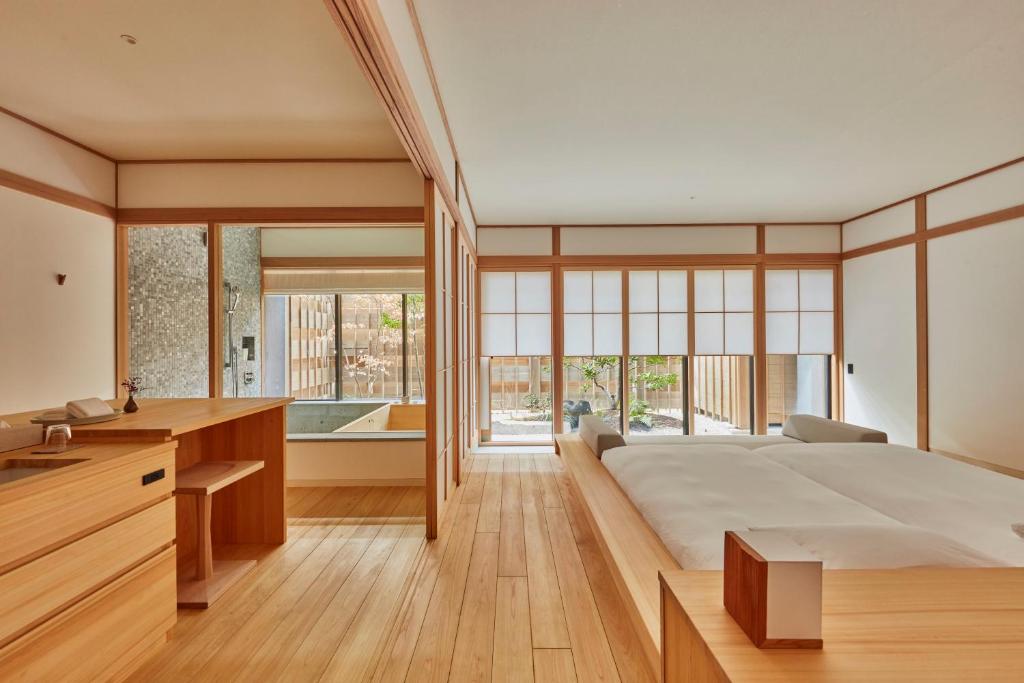
4 Azumi Setoda
- Area
- Takehara & ShimanamiNear Setoda Port on Ikuchi Island, by ferry from Mihara or Onomichi
- Price guide
- US$600–1,400 per night
- Best for
- Cyclists on the Shimanami Kaido and travelers who want slow island time
Highlights
✅ On Ikuchi Island, right on the Shimanami Kaido route
✅ A restored estate of a family that grew rich on salt and shipping
✅ Meals built on island citrus and Inland Sea seafood
Why stay here
The Shimanami Kaido links Onomichi in Hiroshima to Imabari on Shikoku island, hopping from island to island over a chain of bridges. It’s one of Japan’s most famous cycling routes.
Azumi Setoda sits in Setoda, a small port town on Ikuchi Island along the route. It’s a restored estate of a merchant family who made their fortune in salt and shipping, all natural wood and soft light.
Meals use island citrus and Inland Sea seafood. Choose it if you want to ride the Shimanami Kaido, or simply slow down on a quiet island.
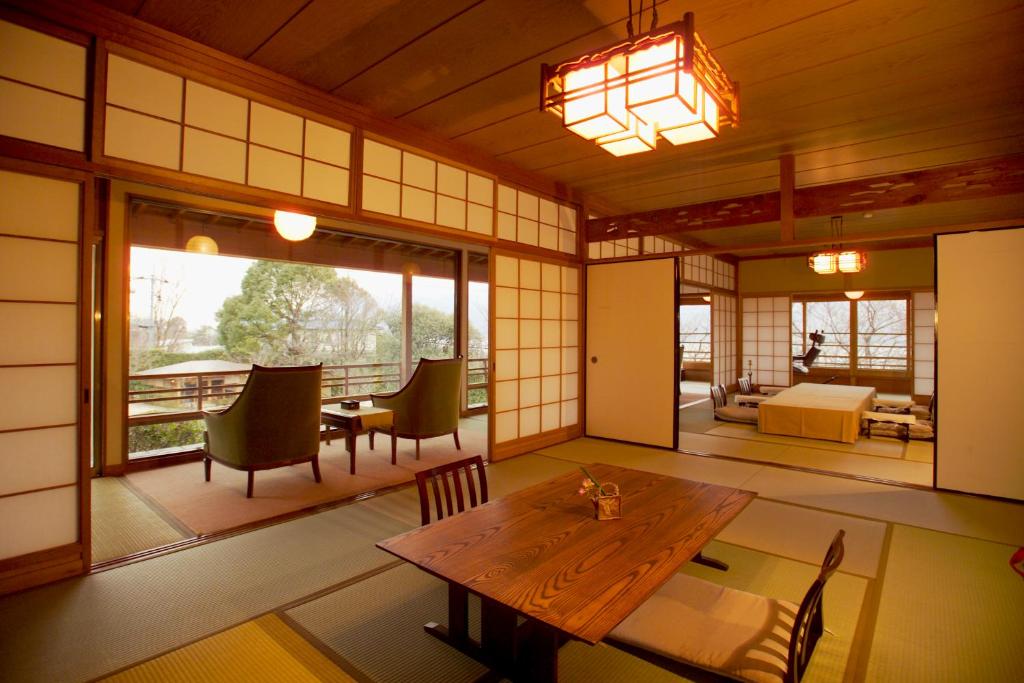
5 Garden Inn Sekitei
- Area
- Miyajima & MiyahamaMiyahama Onsen, ~5 min by car from JR Onoura Station (shuttle on request)
- Price guide
- US$700–1,000 per night
- Best for
- Couples who want a garden, a hot spring and total quiet
Highlights
✅ On a hillside facing Miyajima across the water
✅ A small inn with rooms set around a Japanese garden
✅ Shuttle from JR Onoura Station when you request it
Why stay here
Sekitei sits on a hillside above the sea in Miyahama Onsen, a small hot-spring area on the mainland facing Miyajima. Past the Japanese garden, the Seto Inland Sea and the island spread out in front of you.
Most rooms are separate buildings scattered through the garden, so there’s no busy lobby. Stroll the garden, soak in the onsen (hot spring) and have dinner served in your room. This is a place for doing very little, beautifully.
Instead of staying on Miyajima, you look at it from across the water. If you’re coming from Kyoto or Osaka and want a reason to add a night in Hiroshima, this is the one to pick.
6 Iwaso Ryokan, Miyajima
- Area
- Miyajima & MiyahamaIn Momijidani valley on Miyajima, walkable to Itsukushima Shrine
- Price guide
- US$450–750 per night
- Best for
- Travelers who want a classic, quiet ryokan on the island itself
Highlights
✅ A riverside setting in Momijidani valley, a walk from the shrine
✅ A long-established Miyajima ryokan with some detached cottage rooms
✅ Hot-spring baths, with dinner and breakfast on site
Why stay here
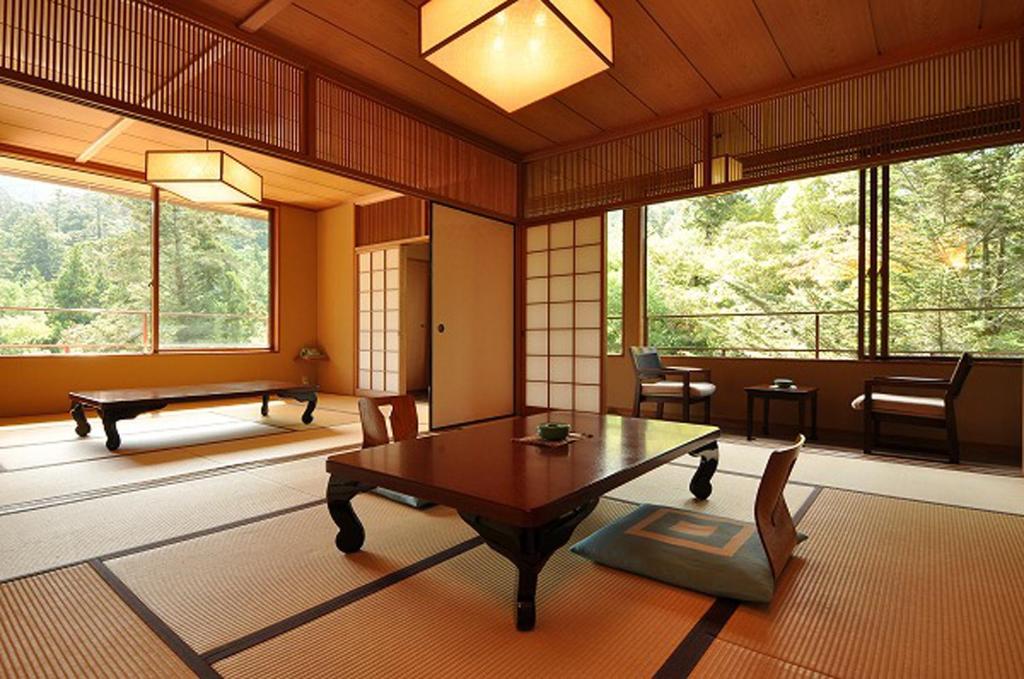
Most people visit Miyajima as a day trip. When the last crowds leave in the evening, the shopping street goes quiet, deer wander the lanes and the lit-up shrine seems to float on the water. That Miyajima belongs to overnight guests.
Iwaso is a long-established ryokan (traditional Japanese inn) beside the river in Momijidani, the “maple valley.” In autumn the trees outside the windows turn red, and the detached cottage rooms are the quietest.
Walk to Itsukushima Shrine early the next morning, before the first ferries arrive, and you’ll have it almost to yourself. That alone is worth the night.
7 Itsukushima Iroha
- Area
- Miyajima & MiyahamaAbout 5 min on foot from the ferry pier and the shrine
- Price guide
- US$450–650 per night
- Best for
- Travelers who want to stay on Miyajima but prefer a newer, modern building
Highlights
✅ On Omotesando, the main shopping street between the pier and the shrine
✅ A newer building with a modern feel
✅ Step out for an evening or early-morning walk when the streets are empty
Why stay here
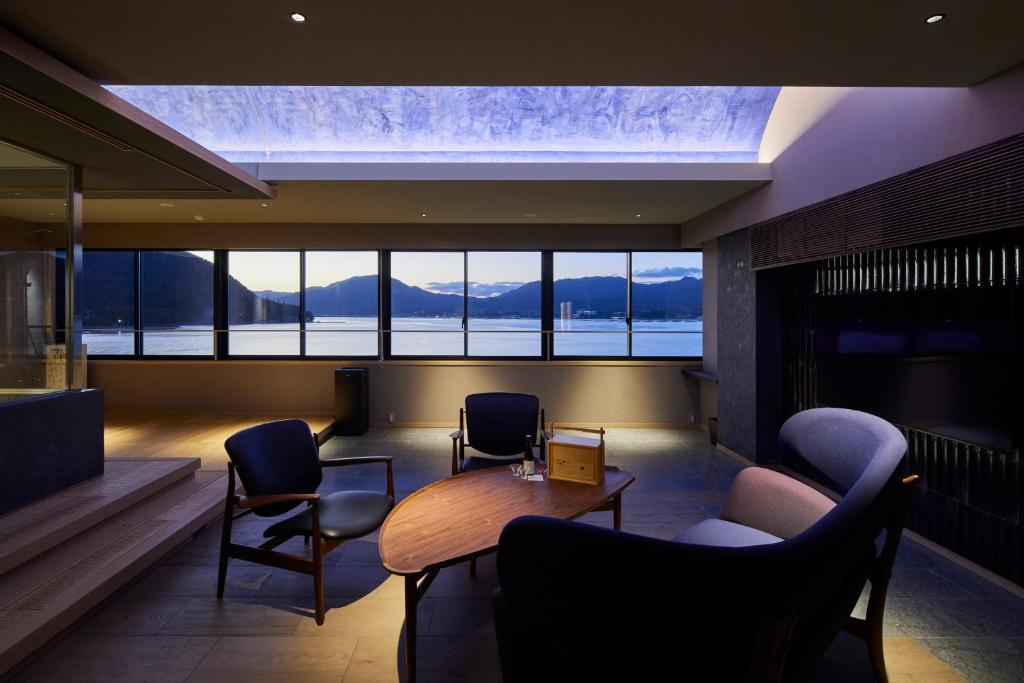
Itsukushima Iroha (formerly Kurayado Iroha) sits on Omotesando, the main street between the ferry pier and Itsukushima Shrine. You can walk there straight off the ferry, even with luggage.
If Iwaso is the classic inn in a quiet valley, Iroha is the modern ryokan in the middle of everything. When the shops close and the crowds leave, you can step right out for a walk along the waterfront.
Either way you get Miyajima at night and early morning. Choose Iwaso for history, Iroha for a newer building and convenience.
8 NIPPONIA HOTEL Takehara Saltworks Town
- Area
- Takehara & ShimanamiInside Takehara’s historic preservation district
- Price guide
- US$300–600 per night
- Best for
- Travelers who love old streets, sake and a slower pace
Highlights
✅ Stay right inside Takehara’s preserved old town
✅ Rooms in restored historic buildings spread around the neighborhood
✅ Local sake breweries within walking distance
Why stay here
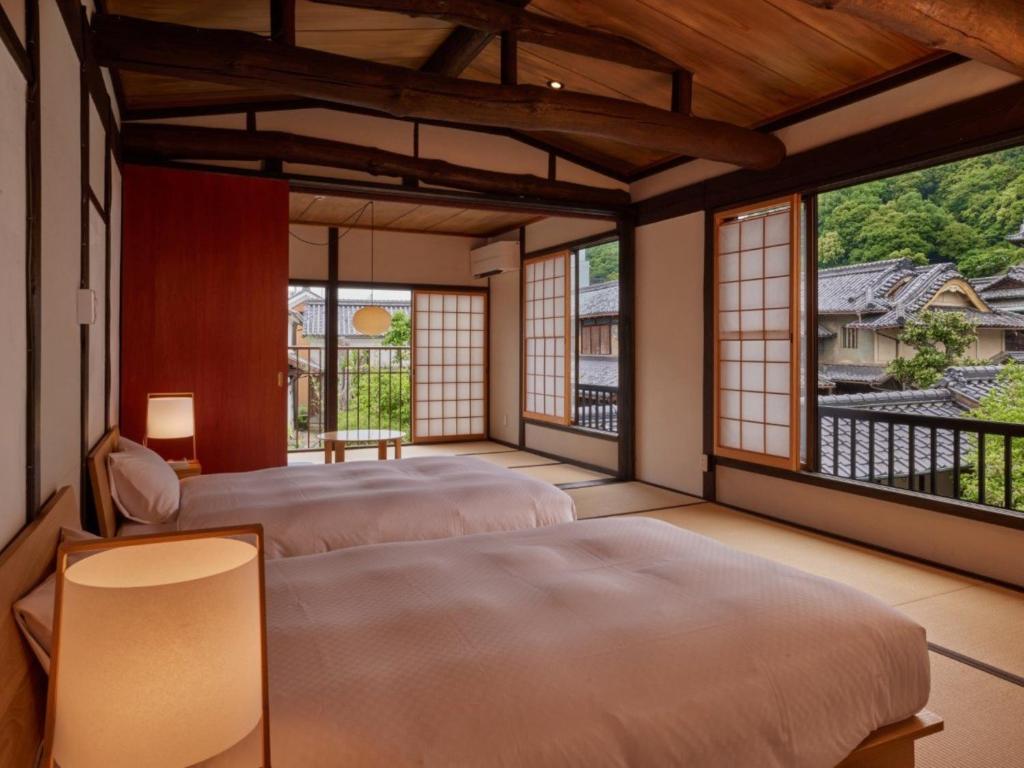
Takehara is a small port town that grew rich on salt-making in the Edo period (1603–1868). Its streets of latticed wooden merchant houses and sake breweries earned it the nickname “Little Kyoto of Aki.”
NIPPONIA HOTEL turns several historic buildings inside the preservation district into guest rooms, so the town itself becomes your hotel. In the evening, after the day visitors leave, you can walk the old streets almost alone.
It’s a quiet, very different side of Japan from both Hiroshima city and Miyajima.
Tips Before You Book a Hotel in Hiroshima
How far is Hiroshima from Osaka, Kyoto and Tokyo?
Closer than most people think. Hiroshima is on the same shinkansen (bullet train) line as Osaka and Kyoto: about 1 hour 20 minutes from Shin-Osaka and about 1 hour 35 minutes from Kyoto on a direct Nozomi train. From Tokyo it’s about four hours, so most travelers stop in Hiroshima between Kyoto or Osaka and points west.
If you’re using the Japan Rail Pass, note that Nozomi trains need an extra supplement. Hikari and Sakura trains are fully covered, though you may need to change at Shin-Osaka.
Travel times from Hiroshima Station
Approximate time on board. Transfers and waiting time not included.
Peace Park and Miyajima
Shinkansen (Nozomi)
Shinkansen times are for direct Nozomi trains. Miyajima: JR to Miyajimaguchi (25–30 min), then a 10-min ferry.
Pay for local trains and streetcars with an ICOCA or Suica IC card, which you can also add to the Wallet app on an iPhone. Moving on to your next city? Ask your hotel about luggage forwarding, a common service in Japan that sends your bags ahead.
Visiting the Peace Memorial Park and the Atomic Bomb Dome
The Peace Memorial Park sits near the spot where the atomic bomb exploded on August 6, 1945. On the riverbank stands the Atomic Bomb Dome, the ruined shell of a building left as it was, now a UNESCO World Heritage Site. The park also holds the Peace Memorial Museum and the Children’s Peace Monument.
From Hiroshima Station, take a streetcar to Genbaku Dome-mae (about 15 minutes). Give the museum plenty of time and go early in the day if you can, as it gets crowded. It’s a moving visit, and many travelers plan a quiet evening afterward.
Getting to Miyajima: JR and the ferry
Take the JR Sanyo Line from Hiroshima Station to Miyajimaguchi (25–30 minutes), then walk to the pier for a 10-minute ferry to the island. Two companies run ferries, JR and Matsudai. The JR ferry is covered by the Japan Rail Pass.
Everyone arriving on Miyajima by boat pays the Miyajima Visitor Tax of ¥100 per person. If you buy a regular ferry ticket or use an IC card, it’s included in the fare. Japan Rail Pass holders buy a separate ¥100 ticket at the ferry terminal.
Why stay overnight on Miyajima
Most visitors leave Miyajima by evening. Stay the night and you’ll see the shrine lit up after dark, have the lanes almost to yourself, and meet the island’s wild deer on an early-morning walk.
The torii gate looks completely different with the tides. At high tide it seems to float on the sea, and at low tide you can walk out on the sand close to it. Staying overnight lets you see both.
First ryokan? What to expect
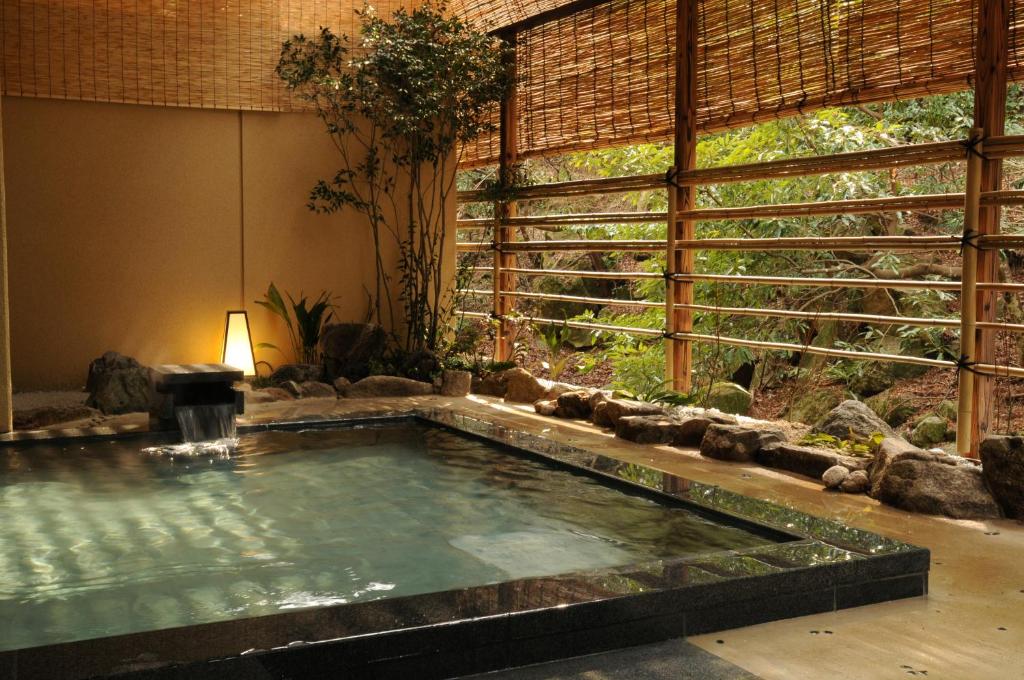
At a ryokan such as Iwaso, Sekitei or Azumi Setoda, dinner and breakfast are usually part of the stay. Dinner is a multi-course seasonal meal served at a set time, so check in with time to spare and don’t book a restaurant for that night.
You’ll walk around in a yukata (cotton robe) and bathe in shared or private hot-spring baths. Some baths have rules about tattoos, so ask in advance if that applies to you. Tipping isn’t expected anywhere in Japan.
Getting to Setoda and Takehara
Setoda, on Ikuchi Island, is reached by ferry from Mihara Port (about 30 minutes) or Onomichi Port (about 40 minutes). Mihara is a shinkansen stop east of Hiroshima. Takehara is a quiet town that’s best enjoyed overnight rather than as a rushed day trip.
So, Which Hiroshima Hotel Should You Book?

Start by deciding what matters most: the city and the Peace Park, Miyajima at night, or the old towns and islands of the Inland Sea.
If in doubt, start with Sheraton Grand Hiroshima, an easy base on the bullet-train line for trips to Miyajima, Takehara and Setoda.
To walk to the Peace Park and downtown, with a pool and spa to come back to, choose Hilton Hiroshima.
If the stay itself is the point of the trip, head out of the city. Architecture lovers should book Simose Art Garden Villa, and for island life on the Shimanami Kaido, Azumi Setoda.
For a garden, a hot spring and a view of the island, go for Garden Inn Sekitei; for a quiet night on Miyajima at a classic ryokan, Iwaso. For a modern, central stay on the island, there’s Itsukushima Iroha, and for an old merchant town, NIPPONIA HOTEL Takehara.
A simple plan: night one in the city, night two on or facing Miyajima, and one more night in Takehara or Setoda if you can. Hiroshima is too good to rush through.
About the author: Yuki Sakaguchi
Travel writer and author with 15+ years of experience, now based in Japan after living in France and Canada. Travels with family, including a 9-year-old daughter, with a focus on exceptional hotels, food and unique experiences.